
Articles and opinion pieces are fun to write – and read, I hope. They offer food for thought, arouse different emotions and give a glimpse into the workings of the global economy and international political landscape. However, focusing too much on analysing data and economic trends may sometimes stray us away from what truly defines economics: people and human interactions.
Behind each story, piece of theory or economic term lies its own unique tale and personal anecdote; a nuance that cannot be done justice in a short 5-minute post. Hence, for a brief change of pace, here is a more “bloggy” – i.e. personal – post that offers a look into the life of the writer (me!).

The “about me” -page is a pretty good place to start. I’m a student, simply put, fascinated by economics. It is an incredibly rich subject that encompasses and thematically intersects with countless other topics: be it (human or physical) geography, mathematics, biology, sociology, environmental studies, anthropology, statistical analysis, law, political science, international relations or however many other topics, economics is never too far away. “Real” economics transcends textbook theory and attempts to define the way we, as humans, live together. Look at it that way, and it’s no wonder why this subject has me (us) reeled in.
Every good story needs a backstory
Being so fond of economics, I naturally keep my ears perked up for news and events relating to it – both on an international stage and domestically: this is where the “Generation €uro Students’ Award” competition (or G€SA colloquially) comes in.
A quick look through their website will tell you that G€SA is an economics competition hosted by national central banks wherein students assume the role of the ECB’s Governing Council and develop their own monetary policy decisions. It is comprised of three rounds: an online quiz, an essay and a final presentation in front of judges. With my full intention being merely testing the waters to get a feel for what it was like to then go full steam ahead next year, I decided to enroll as part of a three-person team. Chat-GPTs one and only contribution to the project would be choosing our team’s name – a triviality that seemed insignificant for a try-out team.
After (perhaps not so gracefully) scraping past the first round, the road ahead seemed bumpy. However, having nothing to lose, my personal feeling was one of determination – underdogs are often praised for their grit, after all.
Writing the essay was a lot of fun, and not in the artificial “fun” kind of way. It was truly, genuinely fun: writing, brainstorming, collecting ideas and finding data, reading articles, the whole shebang. Adopting the role of the Governing Council and drafting our own monetary policy decision in anticipation of the real Governing Council meeting was a novel but exciting exercise.
I also loved being able to express creativity through concocting our own charts and emulating the style of real-life newspapers – it gave our contribution an air of importance and proved to be an important differentiating factor. And hey, if you ever find yourself wondering exactly what colour codes The Economist’s style guide uses, you know who to call.

As thoughts became words and words became paragraphs and the text began finding its final shape, the prospect of making it through did not seem so distant. Momentum was on our side.
After the conclusion of the second round had dwindled the number of remaining groups to just three, the final promised to be a thrilling culmination to the challenge: now, our job was to transcribe our essays into a live presentation. Although one could get away with sprinkling fancy terminology and concepts during the second round, our knowledge would be put to the test in the final Q&A session with a panel of judges from our respective central bank.
Making the presentation was not as easy as it may seem. Although now we had a strong grasp on where to find reliable information and on how to structure our contribution, our decision on the key interest rates (the single most important thing off which everything else is based on) was still very much uncertain. The final took place at an awkward time right between two monetary policy meetings, resulting in a tug-of-war between arguments for cutting rates and for keeping them stable.
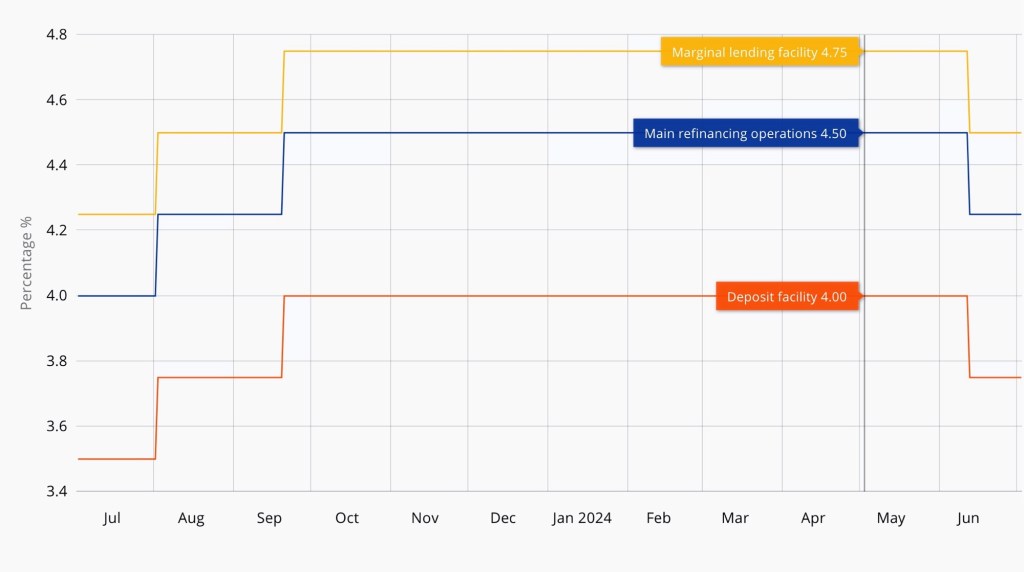
The key point of contention would prove to be the hot labour market which still exerted upwards inflationary pressures in a context of widespread disinflation. After considering that achieving economic growth is not a primary mandate of the ECB, our bets were hedged for keeping rates put. Some of the spoils of the work have actually already been featured in another post.
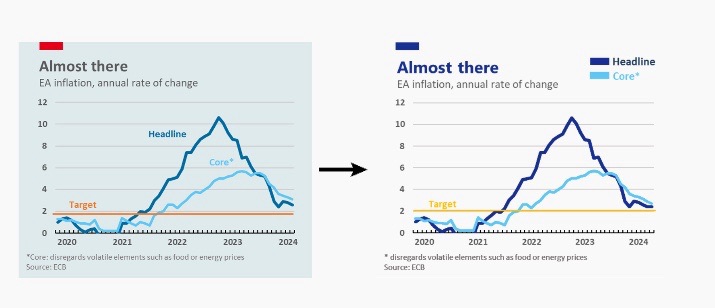
The most fun (looking back) or terrifying (in the moment) aspect of this round was that new data that was constantly being pumped out by the European statistical office or Eurostat – which we naturally had to account for. With new inflation data coming out just days before the final, our fingers were crossed for it to support our stance in order to cement our confidence (i.e. for disinflation not to be fast, sorry!).
After months of work, weeks of practice and favourable inflation data backing us up, we delivered our final presentation. All’s well that ends well, as we ended up snatching the top spot. A pleasant bus ride home, a victory pizza and good night’s sleep later, I felt a huge pressure rolling off my shoulders.
So what’s with the title? Okay, let’s address it. Laureates of this competition are awarded, amongst other wonderful surprises, a trip to the European capital of central banking. Typically this trip included an award ceremony at the ECB presided by the president. However, due to some tricky circumstances involving the competition shifting from a centralised position organised by the ECB to NCBs and a coinciding end-of-year test schedule, the event ultimately did not materialise.
Sorry for the anticlimactic ending – there is a reason I have not been drafted to write movies for Hollywood yet. But believe me, the entire experience was superb regardless. Through G€SA, I have been able to build a much, much, stronger foundation in economics, the competition has offered me a (rather generous) glimpse into the magical world of central banking and it has provided me with skills that will last me a lifetime. If you rolled out of bed today thinking that you would not have to hear about any “the journey is better than the destination” clichés, think again!
Just as every good story needs a backstory, sometimes the backstory is better than the goal – and that is not to say that I did not receive anything else in the end. Regardless, this experience is a sign of much still to come, and I look eagerly forward to what it might be. And who knows, another chance may just be waiting around the corner.
 Economitron

Leave a comment