

At its core, economics is a study of complex systems. With its countless market players, variables and indicators thereof, economists attempt to draw patterns, untangle and predict the behavior of an incomprehensible net of interactions. To help explain and visualize economic theory, economists employ the principles of game theory.
Game theory describes the motives that govern interactions between rational players. It is a mathematical model for what courses of action within any given premises would maximize individual or collective gain. Many different thought experiments feature game theory, from the prisoner’s dilemma, the pirate game to even the fan-favourite rock paper scissors.

Today, the focus will be on one game that showcases the idea of cognitive hierarchy, an interesting concept within game theory. Picture the following:
Within a room of 100 people, each person is told to guess a number that will represent two thirds (2/3) of the average of all guesses. The person (or persons) that gets closest to the average wins a cash prize. In a random setting, choosing 33 as being two thirds of 50 would not be such a bad bet. However, chances are that – if everyone is in in the game – the average will not be 50, but rather a figure between 0 and 66.
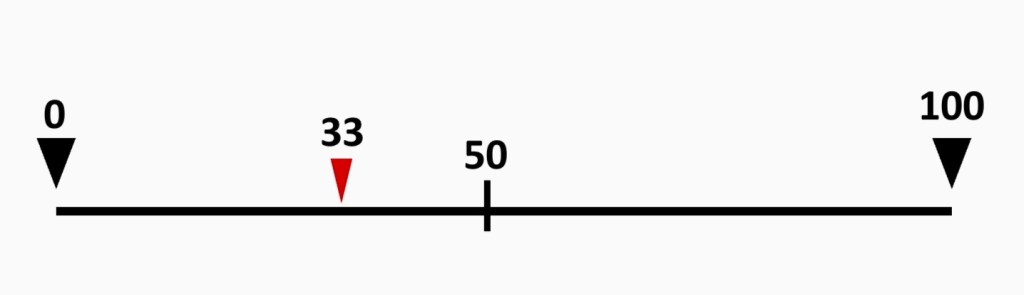
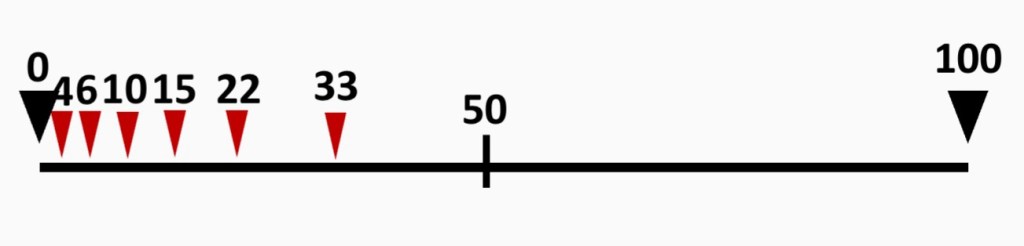
This is where cognitive hierarchy theory comes into play. What might others be thinking? A central question in life, and game theory is no exception. A savvy player may realize that, if most players choose 33 based on the average of 50, choosing two thirds of 33 (i.e., 22) could be a valid strategy. This “one step ahead” attitude nets players with their respective spot in the “cognitive hierarchy”, often expressed as level-k (k being the step each participant are operating is). For example, a level-0 will place their bet completely randomly with total disregard for what other players will do. A level-1 will, anticipating an average of 50, choose 33. A level-2 will go with 22 and so on.
It is easy to see where this leads us. Perpetually undercutting the average will eventually result in the answer of 0. If everyone were to choose this point, a (Nash) equilibrium would be reached by which everyone benefits equally. Hence, logic suggests, the “correct” way to answer is to choose 0.
But that begs the question: is it really? Neoclassical utility theory and such “optimal pathways” postulate that consumers or players always act rationally in their best interest. However, real-world experience will quickly rebut this assumption: though we may strive to, more often than not our decisions are not based on rationality. Asking a room full of 100 economists may result a consensus of zero, but for the laypeople, zero will seem like a remote answer.
Could a player have a k level elevated enough to (1) realize the optimum point but (2) also realize that choosing the optimum would be disadvantageous given average premises? Could they intentionally opt for, say, 33 to conform to the norm? This can be turned up a notch: could someone predict that enough players will intentionally refrain from zero in favour of 33 and choose 22? The end result is a cycle and a conundrum to say the least.
What would you do in this situation, having reached the same conclusion of zero as above? Would you swallow your pride and go with the flow, or would you stick to your guns and go for nil? Wouldn’t that be, in itself, irrational?
This predicament applies to many other things in life: for instance, an engineer or an economist may realize a much more efficient system for waiting in line at the grocery store. Trying to implement this new method would, however, be futile, for the system in place exceeds the reach of the average shopper. They will have no choice but to wait inefficiently and become a part of the problem.
Thinking ahead is also pertinent to (business) relationships, interactions, transactions and economics at large. In a differentiated market, outthinking competitors may make the difference between being highly competitive and slumping into mediocrity. Honing one’s k level and ability to preempt actions gives an edge and helps maximize returns. In the complicated game of economics, being the most astute player at the table may just give that starting advantage required to snatch victory.


Leave a Reply