

I’ve been busy learning these last few weeks. I’m almost halfway into my undergrad studies, which means that first-year dullness has been washed away by an uninterrupted stream of new ideas competing for my attention. My coursework is now consistently reminding me of the reasons I chose this career path and why I began writing this blog. More than anything, these reminders are glimpses into what I’m venturing towards.
I now understand better than ever before the heft of all that I’ve yet to learn. As the world that I grasp expands, so do the boundaries of what I don’t know. And widening boundaries means greatly increasing the directions of where to look. Simultaneously and all at once, I’m getting introduced to new techniques to match a nascent understanding of big questions in economics, how models evolved over time, and where the science is headed.
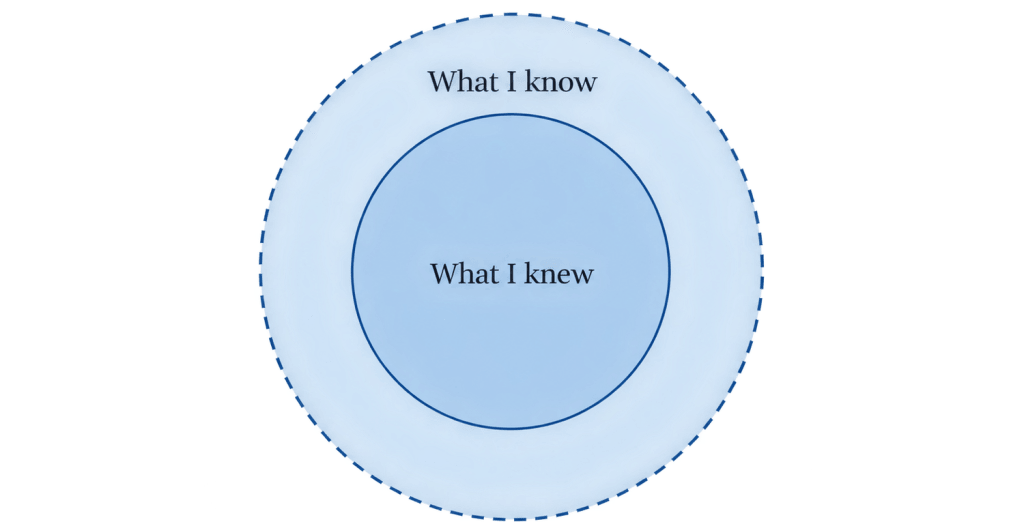
I’ll add to this reflection by sharing some of the big thoughts that I’ve been confronting as of late. These are three questions that I believe will define how we think of central banking in the years to come.
- What should central bank communication look like?
- In which direction should our approach to discretion go?
- Can we think of our central banks as being independent?
Communication is key
Communication is a fascinating topic that I’ve written about before. How rational agents perceive policy can differ from what is intended, and expectations affect the real economy through wage setting and consumption. The policy authority must hence manage its mandate all whilst keeping expectations anchored. But the question is: how should expectations be anchored? Or in other words, what should central bank communication look like? The answer to this question has enormous repercussions for stability and policy discretion.
Look at coursework, and it will say that a central belief of economic theory in the 1970s was that only unexpected variations in monetary policy could affect real economic variables. Forward guidance would have been a no-go under these assumptions. Later revamps to theory muddle the picture with stickiness in prices and wages, giving somewhat of a role to market guidance.
More interestingly, ask the current chairman of the Federal Reserve, and he’ll tell you that central bank communication has been moving in the wrong direction. Since the low-for-long era after the 08′ crisis, Warsh characterises a tendency to overshare policy actions. Once the lower bound of nominal interest rates began constraining the standard toolkit, policymakers shifted to staying afloat through managing expectations. The fringes of unconventional monetary policy became normality, and terms such as state-contingent forward guidance became part of the common lexicon.
Warsh’s remarks
Oversharing policy deliberations and overcommitting to future decisions can lead markets, businesses, and households astray. And I believe when policymakers make quasi-commitments on interest rates through the cycle, we inhibit our own freedom to make the right calls when it’s time to decide.
So is Warsh right in urging for more restraint? In holding fewer monetary policy meetings during the year, and in bringing up communication only if it is to condemn it? Whilst explicit divulgence of future policies is certainly not in modern central bankers’ toolkits, many forms of ‘soft’ communication do exist. For example, the BOE and (for now) the Fed are transparent about their individual policy-setters’ voting records. These members are then free to give, within their professional capacity, public interviews and economic commentary in between meetings. The Fed additionally publishes a dot-plot of forward-looking expectations for interest rates.
Such communication fosters better transmission of monetary policy, smoothness in financial markets, and trust between the policy-setter and the public. It grounds market observes and sets the tone for discussions on economic conditions. For instance, during the disinflation of 2024, financial easing was front-loaded through expectations of future easing. This caused unwarranted upticks in demand and upside inflationary pressures. Clear communication can alleviate frictions in such settings.
However, communication can be the source of friction if markets focus too much on the central bank. The Hall of Mirrors Problem describes the distortion created by market participants incorporating the central bank’s signalling into their own forecasts. Signal extraction then becomes harder for the policymaker, who has to avoid its own reflection in the data. Too much emphasis on central bank guidance for economic analysis can furthermore worsen market participants’ own analyses of economic projections.
But perhaps even most importantly for our question, where communication becomes really contentious is when it starts advising on future policy.
Putting handcuffs on policy
What if the central bank wants to control inflation expectations directly, and thus tries to commit to future policy paths? Again, coursework has shown that controlling inflation expectations through commitment results in better policy outcomes than that under meeting-by-meeting discretion. This is because inflation expectations for tomorrow affect inflation today. Inflation expectations can hence work as an additional lever policymakers can pull on, and the most potent way to do this is by committing to future policy action.
Why the tides are against (and turning more and more away from) commitment comes down to issues over practicality.
One such practicality is freedom. Warsh alluded before to the ills of inhibiting policymakers’ discretion over policy by being too communicative over future action today. Commitment is time inconsistent, meaning that the central bank has to shy away from its ex-post optimal policy to keep to the path it has committed to (more about this here). This freedom becomes even more relevant in a world filled with uncertainty over shocks and how they transmit through the economy. Sustaining state-contingent commitment under uncertain environments can result in mixed messaging and even create fragility from reputation-based multiple equilibria.
Moreover, affecting inflation expectations is difficult because they are inherently subjective. Say the ECB comes off as more dovish than anticipated: one analyst might increase growth forecasts due to the unexpected downside risk to interest rates; the other may take it as a signal for economic weakness and thus decrease their forecasts. How should a central bank go about communication to manage expectations? Too innocuous, and it risks generating ambiguous signals. Too imposing (“we will deliver X inflation given Y happening“), and credibility will face a big test.
The ECB seems to have struck a middle ground by being data-dependent (i.e., monetary policy will be decided at each meeting given the available data) whilst being vocal about its reaction function. It thus leverages its credibility by saying no to announcing future policy actions but yes to soft guidance through reaction function.
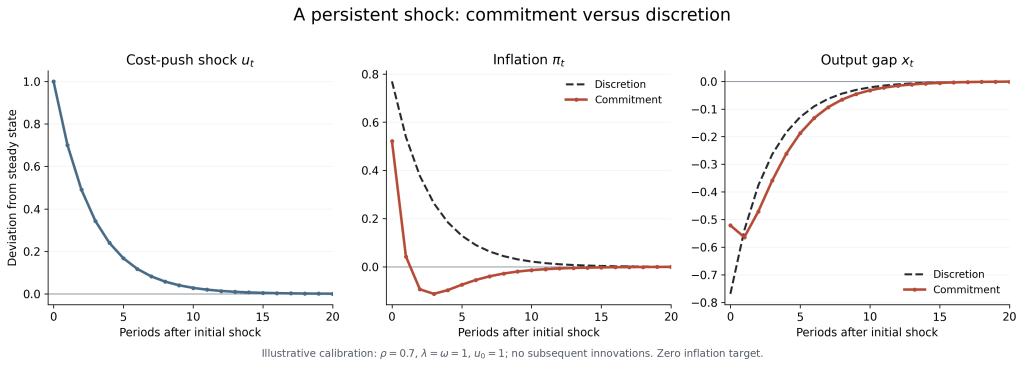
However, it is clear that under this setup they fail to harness all the possible policy benefits prescribed under commitment. How policy moves to manage expectations well enough to emulate those benefits is a question central banking has yet to satisfactorily answer.
The big question
This discussion on communication and commitment has leaned heavily on the assumption that monetary policy is independent to act with discretion to begin with. Like the others, this topic deserves a post of its own, so I’ll keep my reflections brief.
Central banks should be independent to act with discretion. The third question concerns political independence in a world where central bank balance sheets could (in the short-term) solve many headaches for indebted countries.
Policymakers have an incentive to avoid multiple equilibria that could foster financial instability through yields skyrocketing or worse. More importantly for independence, central banks have the tools available to purchase government debt if markets punish governments with high yields. Take the ECB’s Transmission Protection Instrument as an example: instituted in 2022, it allows the ECB to intervene where it sees unwarranted market repricing of sovereign yields. Although it’s meant to consider fiscal sustainability criteria, the truth is that its activation conditions cannot be applied in an objective manner.
Call it TPI, call it a credible backstop for disorderly market mechanics, or call it blatant intervention, the truth is that fiscal policy today i) muddles with the transmission of monetary policy and ii) makes central banks susceptible to political pressure. This idea is nothing new and has precedents, but current bond blowups across the world have placed it front and center. There have been high-ranking resignations in the ECB over a shift towards greater market intervention, and the issue is set to continue for as long as governments keep racking up their deficits.
These are the questions that I think will shape our discussions on how monetary policy should be conducted. They cover the structure of policy, how it’s presented to the wider public and how it fits in the world around; by better understanding one, we uncover something about all of them.


Leave a Reply