

This post will serve as a short personal reflection whilst I work on better things to come. As promised, it features no linear regressions.
I was met with my first taste of a serious professional experience earlier this year. Not in the public sector, which is too eager to gatekeep bachelor’s students, but at a firm representing the private sector. I came into the experience with mild expectations. But what I found surprised me.
As a young student, I like to envision myself working for the common good. A central banker or policymaker, perhaps. Someone who pursues their passion whilst leaving a tangible imprint on the world around them—for the better, as one hopes.
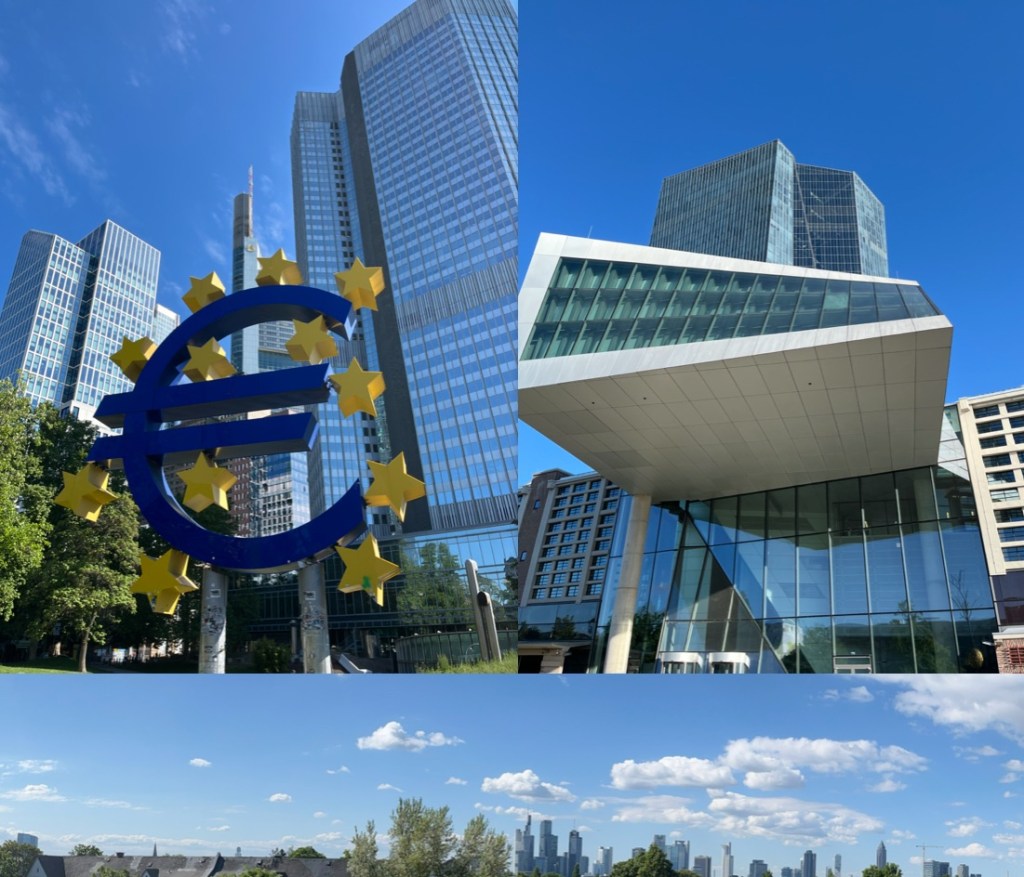
What draws me to the public sector is the notion of meaning. At the European Central Bank’s headquarters in Frankfurt, visitors can revel in the oozing symbolism for European integration. The building is adorned with memorabilia and quotes engraved onto the cement, presenting itself as a fortress of economic power at the intersection between stability and unity. To work at such an institution is a statement of belief in all for which it stands.
The public sector feels special. It seems like a purpose-driven, unpretentious and unique aspiration with no unsavoury clichés hanging over it.

That’s why I did not expect much from my experience. It is in a field of economics & finance I adore, but shareholder profitmax did not strike me as an inspiring objective function. Why try to predict policy decisions and trade on those hunches, when I could be the one taking the decisions? Profit&Loss and interest rate decisions are both numbers on a screen. But enriching the analyst and shareholders would personally never amount to the same level of meaning in retrospect as delivering economic stability.
So, what’s with the surprises? Three positive aspects stuck out to me that have made me look at work at the private sector in a different light.
First is the breadth of opinions, ideas and personalities working at multinational corporations. When an institution loses the larger-than-itself ideological mould that in my eyes gives meaning to work in the public sector, its values are replaced by what individuals bring to the table. Like-minded individuals will always exist, but the multiplicity of ideas in such institutions is truly unparalleled.
Naturally, the work is also fun. Personal challenges, flexibility and vertical mobility are all embedded into the private sector work culture. I often heard people say that every workday is different, which cannot be said about those who chose to become micro-modelers in international institutions (amongst many other roles). And whilst setting policy carries an undeniable aura, beating other market observers with the exact same information set as you purely with intuition is at the very least just as exhilarating.
Last is the most important point, meaning. Meaning is something that a young ideologue cares about. The sentiment then subsides in the middle stages of life, and comes back when one has nothing left but the what once was; the what might have been. To avoid regret is to stay true to oneself. Hence, work has to be fun but ultimately meaningful.
A discussion I had on my final day of the experience on this very topic made me reconsider everything. It came from meeting someone in whom I saw a bit of myself in, and whom, in any other timeline, I could have pictured working for the other side of the coin instead. It placed the seed of a simple question in my mind: why do I think that in a Europe with excessive fiscal burdens, chronic underinvestment and productivity deficits, the best way to combat its problems is by working for the public sector? The side that is partly responsible for Europe’s ailments and that has proven to be incapable of finding a fix?
The public sector is powerless without a strong private engine. One that facilitates its spending needs and proactively supports and pursues investment. Capital markets are what enable governments to fulfil their objectives, and what provide dynamism to our economy. At an international institution, the client may very well be putting some of the wealth of a nation in your hands. And that matters. If the boardrooms of our local multinational corporations align strategically with common objectives whilst providing shareholder value, then so be it. A world in which EU officials divest their power to a stronger private sector sounds better than one where none of the world’s top 15 banks are European.
Managing to stay undistracted and focusing on the aspect of private sector work that delivers meaning begins sounding less like a compromise and more like an impactful alternative. Ultimately, I eagerly choose to extend this formative insight into a fuller experience in the hopes of better understanding what it is that I want for myself. In any case, I have the security of knowing that these crossroads are not a one-way road. Turning the other way will always remain an option.


Leave a Reply